Intellia Therapeutics (NTLA) appears to be farthest ahead in terms of developing an in vivo gene therapy program in any therapy area. It’s clinical-stage pipeline consist of multiple programs, including HAE, ATTRv-PN, ATTRv-CM, Hemophilia B, Acute Myeloid Leukemia & B-Cell Malignancies. Of these, the HAE clinical program is furthest along in clinical development – and may well be seen as the “make or break” moment for the company, and more widely for other CRISPR-based in vivo platforms. Given the importance and relevance of the HAE program, in this blogpost we try to get a sense of the likelihood that the HAE program might get regulatory approval from the U.S. FDA (PRS). Lonvo-z is being developed as an investigational “one-time” gene editing therapy for HAE patients in lieu of receiving life-long long-term prophylaxis. Let’s dive into the data:
Top-line data from the Phase 3 HAELO trial released in April 2026 demonstrated an 87% Mean Attack-Rate Reduction Weeks 5 – 28 (Primary Endpoint) with a 95% CI of 78%-93% (p<0.0001)
To contextualise these numbers, we benchmark the Phase 3 data against the last 3 approved injectable HAE prophylaxis therapies (Andembry, Dawnzera, Takhzyro):
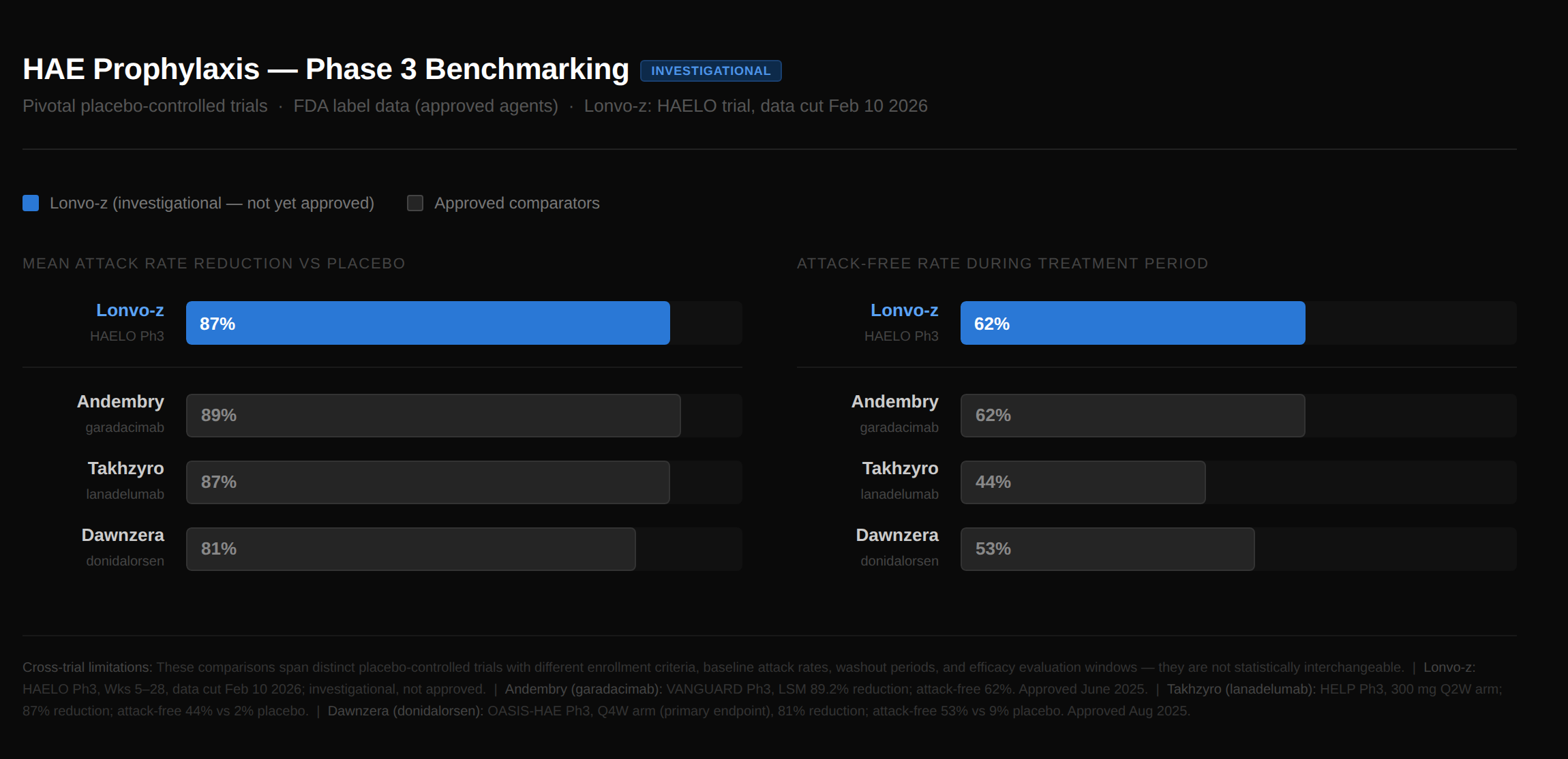
While cross-trial comparisons need to be interpreted with caution, the placebo-adjusted mean attack rate reduction for Lonvo-z (87%) appears to be in-line with the pivotal data from most of the currently approved injectable HAE prophylaxis. Notably, despite numerically identical point-estimates vs Andembry in terms of attack rate reductions (87%), the lower bound of the 95% CI for Lonvo-z (78%) appears numerically superior to the lower bound of the 95% CI for Andembry (58%) – directionally supporting the thesis that the efficacy is at least at par with Andembry. We are also particularly encouraged by the “attack-free” rate for Lonvo-z which sits at 62% – exactly the same as Andembry, and numerically higher than both Takhzyro and Dawnzera. Intellia has itself highlighted the treatment burden associated with these injectable therapies despite clinically meaningful efficacy – with Takhzyro dosed Q2W/ Q4W, Dawnzera dosed Q4W/ Q8W, and Andembry dosed Q4W. Broadly then, HAE patients on the currently approved injectable therapies may be looking at anywhere between 6 to 24 injections a year. The striking aspect here is that Lonvo-z achieved these efficacy figures with a one-and-done approach, which will arguably be attractive to HAE patients that may be seeking a lower treatment burden and some sense of freedom from chronic injectable (or oral) therapies.
Looking at safety, we are encouraged by the lack of serious AEs or Grade ≥3 TEAEs
in lonvo-z arm, and no clinically meaningful differences between arms in clinical chemistries as reported by Intellia. Of particular interest here is the lack of any strong signals related to liver toxicity – though, there was a single Grade 2 ALT elevation observed in the lonvo-z arm, this self-resolved in one week. This is particularly relevant given the prior FDA clinical hold on some of Intellia’s ATTR programs, following reports of a patient death in one of the trials. At the time, some had speculated a potential platform-wide liver toxicity issue, which could in theory affect the HAE program as well. Looking at the available data from the Phase 3 HAELO trial in HAE, while we would have preferred the safety data for HAE to be fully clean of any liver signals, at this stage we do not view this as a strong signal of liver toxicity. Nonetheless, the safety dataset remains small (N=52), and it is possible that rare but serious liver toxicity may show up with Lonvo-z in the real world. At this stage, we do not consider this to be of a very high likelihood, however, this could mean that the FDA decides to impose additional monitoring criteria for patients receiving Lonvo-z.
A high likelihood of US FDA approval, 20 to 45% of US HAE patients may opt in
Overall, given the strength of the pivotal efficacy and safety data and prior approvals of therapies such as Andembry, Takhzyro, and Dawnzera with comparable or weaker datasets, we think the dataset merits adopting a view of a high likelihood of US FDA approval. Our high likelihood estimate is reinforced the prior US FDA approval of the oral HAE prophylaxis therapy, Orladeyo, which had demonstrated pivotal headline attack rate reduction of 44.2% (150mg, QD) vs placebo – which sits substantially below the efficacy figures observed with injectable prophylactic therapies. The one area that still remains to be seen is how cautious the FDA may be in terms of any potential labelling restrictions. Notably, if approved, Lonvo-z is expected to be the world’s very first CRISPR-based in vivo gene-editing therapy. Given that the long-term safety of this approach remains to be established – and the weak but real Grade 2 liver-safety signal seen in the Phase 3 HAELO trial, it is possible that the FDA may adopt a cautious approach towards safety monitoring, including long-term monitoring requirements.
Management has stated that the company has started rolling BLA submission to the US FDA, placing a potential FDA approval in 1H 2027. Intellia estimates ~7,000 HAE patients in the US. Crucially, this will be Intellia’s very first commercial launch – though based on management commentary the preparations for commercial infrastructure build appears to be progressing well. On balance, given the novelty and unique differentiation of the one-time approach – and potential concerns about the safety and long-term effects of permanent gene-editing, our internal modelling (using Spinraza and Zolgensma in SMA as surrogates) suggests that somewhere between 20 to 45% of US HAE patients (cumulatively) may opt for Lonvo-z within 5 years of launch. The broad range for the adoption estimate reflects the uncertainty in the evolving HAE prophylaxis landscape.
What after approval though?
In our view, the key risk to Lonvo-z’s commercial success comes from longer dosing interval investigational assets such as BioCryst’s navenibart (dosed Q3M or Q6M) and ADARx onvuzosiran (Q3M or Q6M) – both currently in Phase 3 trials. Particularly if Q6M regimens demonstrate comparable (e.g. >80% monthly attack rate reduction vs placebo) and gain approval, navenibart and onvuzosiran have the potential to reduce the “treatment burden” that currently appears to be the key unmet need that Intellia is focusing on. Meaningful competition from navenibart and onvuzosiran may not materialize prior to 2H 2028, offering Intellia a relatively thin 12 to 16 months window to capture an initial bolus of patients. Crucially then, pricing and contracting is likely to be a significant factor that will affect the commercial success of the Lonvo-z program.
DISCLAIMERS
General
This article is published by Sequela Research for informational and educational purposes only. Nothing contained herein constitutes investment advice, a solicitation, or an offer to buy or sell any security or financial instrument. Readers should not rely on this content as the basis for any investment decision.
Regulatory Status
Sequela Research is not authorised or regulated by the Financial Conduct Authority (FCA) or any other financial regulatory authority. This content does not constitute regulated investment research or a personal recommendation under the Financial Services and Markets Act 2000 (FSMA) or the UK Market Abuse Regulation (UK MAR). It is published as general commentary and analysis in the public interest.
Conflicts of Interest
Sequela Research has received no compensation from Intellia Therapeutics or any related party in connection with the preparation or publication of this article. Sequela Research has no commercial relationship with any company mentioned herein.
Forward-Looking Statements & Modelling Assumptions
This article contains forward-looking statements, including projections regarding FDA approval probability, patient adoption rates, and commercial launch timelines. These represent the author’s analytical judgement at the time of writing and are subject to material uncertainty. They should not be interpreted as forecasts or guarantees of future outcomes. All modelling assumptions, including the use of Spinraza and Zolgensma in SMA as commercial analogues, reflect the author’s independent methodology and may differ materially from actual outcomes.
Clinical & Regulatory Analysis
Cross-trial comparisons referenced in this article are inherently limited by differences in study design, patient populations, follow-up periods, and endpoints, and should be interpreted with caution. The author’s assessment of FDA approval probability is based on publicly available clinical data and does not reflect any non-public information or communication with regulatory authorities. Regulatory outcomes are inherently uncertain.
Small Dataset Caveat
As noted in the article, the safety dataset for Lonvo-z remains limited (N=52 in the Phase 3 HAELO trial). Conclusions drawn from this data may change as larger, longer-term datasets become available. Rare but serious adverse events may not be detectable at current sample sizes.
No Reliance
Readers are strongly encouraged to conduct their own independent research and, where appropriate, to seek advice from a qualified financial adviser, medical professional, or regulatory expert before making any investment or clinical decision. Sequela Research accepts no liability for any loss or damage arising from reliance on the content of this article.
Date
The analysis reflects information available as of the time of writing the article. The views expressed may no longer reflect current data, regulatory status, or market conditions.
Leave a Reply